
Elina Merenmies: "To me, painting is a miracle"
An interview with Elina Merenmies, Principal of the Free Art School.
Elina Merenmies: "To me, painting is a miracle"
An interview with Elina Merenmies, Principal of the Free Art School.
What does painting mean to you?
To me, painting is a miracle. Thousands of shades and mixing ratios come to mind whenever I need them. I jokingly call it "tube mail." I tell my students too: wait for the tube mail!
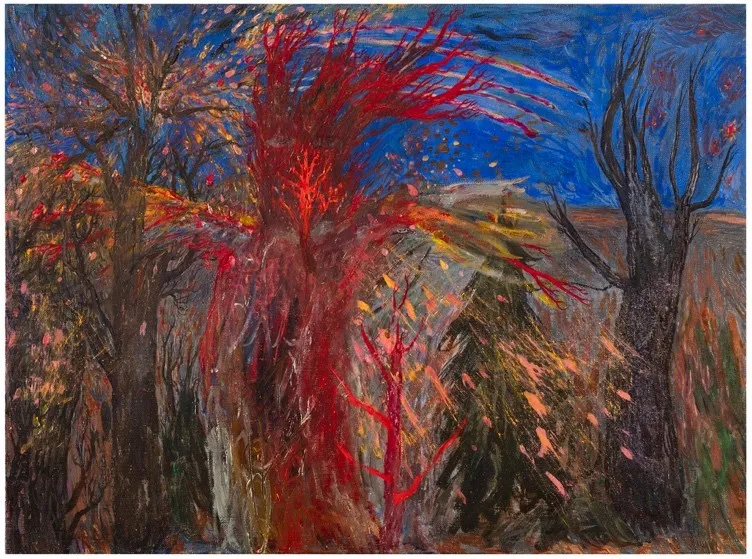
Things appear in a painting that I never planned: all-encompassing images of an experience that has no words, yet whose language people can inexplicably recognise.
A finished work inevitably reveals who I am, and that is exactly as it should be.
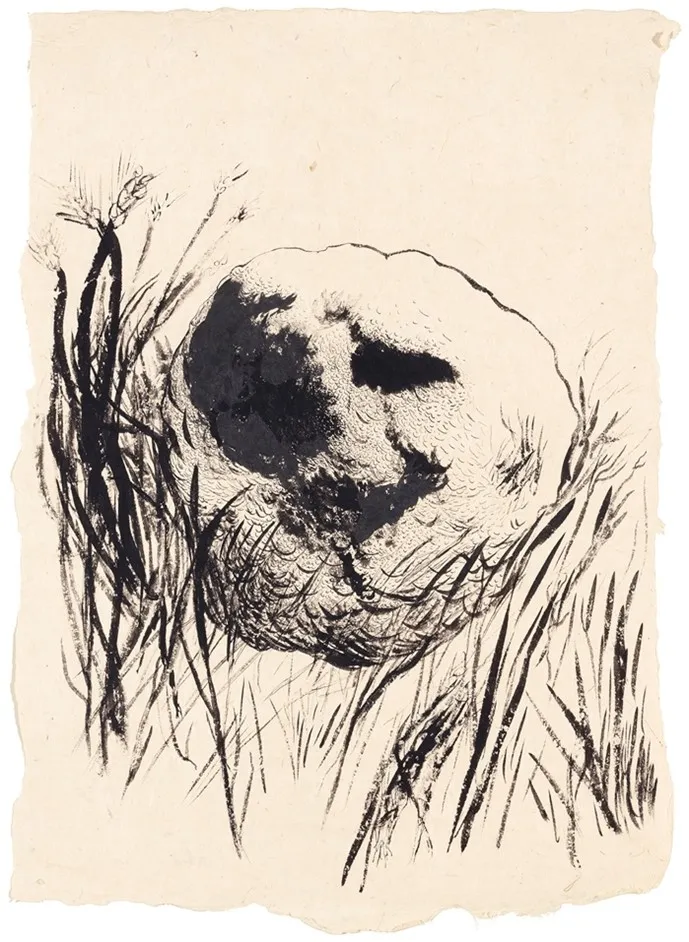
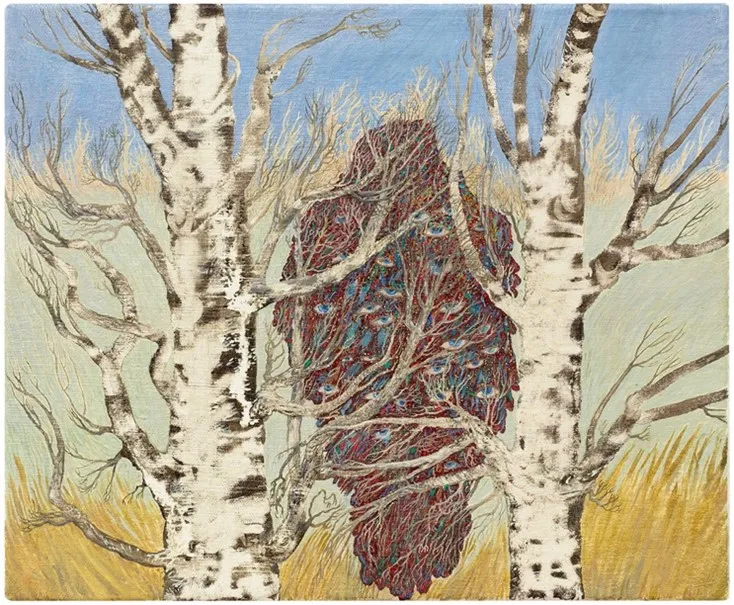
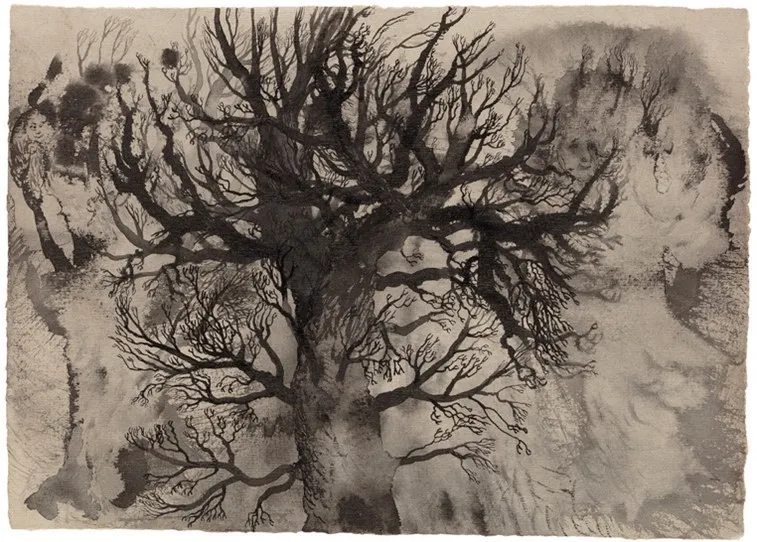
People often wonder why my works are sometimes so dark, sombre, even ferocious. I can't really answer that, but I have a theory. What I want from my art is to break through a certain boundary that lies between things, so that my innermost self somehow "lives" in flat things. Perhaps that breakthrough also connects with human reality, which, if not for everyone, then surely for a great many people, is rather hard to bear and full of suffering. That is an element independent of me: reality.
On the other hand, people often flee from reality. I try to do something like the opposite, while at the same time fighting my own hidden weakness and cowardice. I try to be brave and joyful, and to look at existence, and especially at my own actions, as they really are, trying to correct in myself whatever I can. Then it all bursts out into the painting and surprises even me. A bit like David Cronenberg's film The Fly: an unintended mistake changes the outcome of a scientific experiment, and the tragicomic part of the story truly begins.
I am immensely grateful to live in this time, when I have been able to do what I want in my profession, regardless of my gender or any other obstacles people have invented. I have been free to run riot on the canvas without anyone really trying to restrict me. On the contrary, I have received help and support, and found some unexpected champions of my art.
From my early childhood I remember my first all-consuming painting experience: I was happily painting a turtle made of stones and concrete on the rocks at Haukilahti. It was summer and it started to rain, and the extremely kind and concerned young people looking after us little ones came, picked me up and carried me to shelter. I thought: this really is the best service ever! You get paints and a brush, and when the weather turns, you'd never be left out in the rain. I feel that ever since then, painting has always somehow worked out.
What have your years at the Free Art School taught you?
If someone had told me as a young art student that I would one day become principal of the Free Art School, and that I'd be quite happy in the job despite all the busyness, I would never have believed it. So at least they've taught me that. I've also learned much more about painting and colour, and how to make an Egyptian wood-and-chalk ground, that is, an icon panel.
What is the most important thing you want to teach your students?
I always repeat to them that being honest in everything builds self-esteem, and that you shouldn't do anything in your life that you wouldn't have approved of as a small child. That always makes the students laugh at me, good-naturedly. So I try to teach them to be themselves, the best version of themselves, if that can even be taught. One can try.
Where do you find inspiration for painting?
In good art, and especially in classical music; that's a guaranteed source of inspiration. It's said that composers live in music, and I would like to live there too. But I don't really know where I suddenly get inspiration by the bucketload in the silence of the studio. In those moments I realise that this is exactly what I want to be doing right now. Inspiration comes and goes. Sometimes an idea arrives that I might soon forget if I don't write it down somehow or make a sketch.
Whose student would you have liked to be?
If I could choose only one, it would be Saint Andrei Rublev, the icon painter (d. 1430). I imagine that simply watching his presence and his way of working would have been enough for me, because in his icons one can find an inexpressible beauty and a presence that radiates such exceptional joy and peace.
Which techniques interest you most at the moment?
Oil painting techniques of the 15th to 18th centuries, icon tempera and gilding. I'd love to someday learn and experiment with encaustic, that is, beeswax painting, and also mosaic.
What is the best thing about the Free Art School?
A small school has a homely atmosphere, and everyone feels close. And also seeing how the students work with such concentration, which is always such a wonderful sight! Sometimes the best thing is noticing how even a little encouragement can make a positive difference.
Where did you study yourself?
I started at the University of Helsinki Drawing School in 1987, but then in the spring of 1988, at around twenty, I moved to Belgium. I studied painting for a year and a half at the Institut Saint-Luc in Brussels, which had a small painting department. During that time I was accepted to the Finnish Academy of Fine Arts, but I stayed on in Belgium for another year as an exchange student.
After that I spent a few years in the painting department of the Finnish Academy of Fine Arts, including nearly a year in 1991–92 in the monumental painting studio of the Prague Academy of Fine Arts. Altogether I lived in the Czech lands for almost three years. My graduation exhibition was held at the Finnish Academy of Fine Arts gallery in 1992. I returned to school for a few fairly short periods, all the way up to my Master of Fine Arts degree in 1999.
People often ask me about Paris, whether I ever studied there. I've lived in Paris for perhaps five years in total, in stays of varying length, and even painted works for my master's degree there, but I was never a student at any local school.
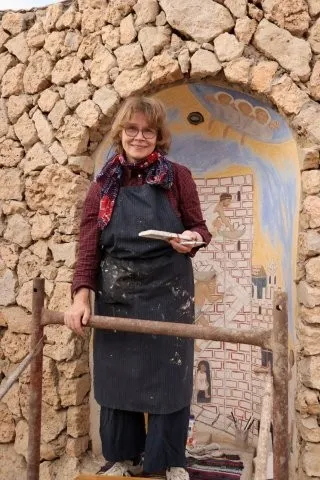
Elina Merenmies
Visual artist, Master of Fine Arts
Born 1967
Works in Helsinki
Education: University of Helsinki Drawing School; Institut Saint-Luc, Brussels; Prague Academy of Fine Arts; Finnish Academy of Fine Arts.
Principal of the Free Art School: recruits visiting teachers, oversees the school's overall curriculum, teaches fundamentals to first-year students (e.g. oil paints and the mixing properties of pigments, ink drawing), teaches the fourth-year class, and is in charge of the graduating painters' final exhibition.